Executive Summary
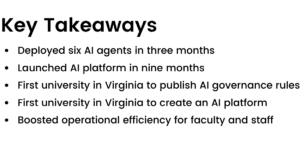
George Mason University isn’t just adopting AI—it’s redefining what a modern university looks like. In three months, the university brought six AI agents live across campus, giving students, faculty, and staff a seamless AI experience through a unified platform powered by Cloudforce nebulaONE®. As the first university in Virginia to create a campus-wide enterprise generative AI platform, George Mason University inspires innovation with hands-on learning opportunities for students, faculty, and staff. The university is positioning its students for success in a world where AI skills are in high demand by pushing the boundaries of what’s possible. George Mason University’s collaboration with Cloudforce demonstrates how universities can transform education with strategic partners.
Background
Strategic growth and innovation are at the heart of George Mason University’s commitment to learning. In just over 50 years, the university has evolved from a college with 17 students to the largest public research university in the Commonwealth of Virginia. George Mason University now supports more than 40,000 students at three campuses in Virginia and one in South Korea, who are eager to be on the cutting edge of AI in higher education.
Challenge: Transforming education with AI
George Mason University leaders focus on equipping students with the skills they need to thrive in the modern workplace. Dr. Gregory Washington, the university’s president, recognized the potential for AI to completely transform higher education, and in 2024, the university set out to bring AI innovation into its educational experience. Chief Information Officer Dr. Charmaine Madison, new to George Mason University in 2024, embraced the task of putting AI tools into the hands of students, faculty, and staff.
“We want AI to make a difference in our students’ lives and their experience here,” says Dr. Madison. “We want to make a difference in our faculty’s ability to instruct and deliver quality content. We want it to accelerate our research and improve operational efficiencies for our staff.”
Dr. Madison and team began brainstorming how to incorporate cutting-edge AI innovation with a modest budget and limited expertise. “I’m a former federal civil servant and retired military, and I understand that when you don’t have resources, partnerships allow you to achieve your mission,” says Dr. Madison.
Dr. Madison shared this vision for AI transformation with Microsoft, which led to the introduction to Cloudforce. “We went to the Cloudforce headquarters and saw a demo of its nebulaONE® platform,” says Dr. Madison. “I immediately became excited about partnering with them to see if we could use nebulaONE as the underpinning of our platform at George Mason.”
We want AI to make a difference in our students’ lives and their experience here. We want to make a difference in our faculty’s ability to instruct and deliver quality content. We want it to accelerate our research and improve operational efficiencies for our staff.
Dr. Charmaine Madison, Chief Information Officer, George Mason University
Solution: Deploying six AI agents in just three months
The George Mason University team quickly began collaborating with Microsoft and Cloudforce to expand the university’s cloud capabilities and develop AI agents tailored to its needs. The university’s internal AI task force had already established a governance framework and specific AI use cases, and the team worked with Cloudforce to turn those use cases into AI agents.
In April 2025 — just three months after partnering with Cloudforce—George Mason University deployed its new platform, called PatriotAI, consisting of six AI agents. Powered by nebulaONE® on Microsoft Azure, PatriotAI agents support specific student and faculty needs. One agent fields routine questions about campus life, such as how to register for classes or where to pick up lunch. Other agents provide tutoring services or help researchers consolidate and analyze their data.
The university also developed a niche agent designed specifically for its diverse student body. “We gave Cloudforce some use cases that they hadn’t seen before, including a student agent called NourishNet, which helps support students facing food insecurity,” says Dr. Madison.
PatriotAI’s rollout was only the beginning. George Mason University continues to accelerate AI innovation through education and learning. The university hosts Cloudforce engineers for hands-on training sessions that teach students, faculty, and staff how to build personal AI agents. The internal task force continues to generate, receive, and vet new ideas for AI agents that Cloudforce can develop and deploy campus wide.
Results: Moving from vision to leadership in nine months
Within just nine months of the president’s initial vision for AI transformation, George Mason University blossomed into a leader in AI innovation in higher education. It was the first university in Virginia to publish an AI governance framework and deploy an AI platform. Grants from Microsoft helped the university deploy PatriotAI at minimal cost and serve as a blueprint for other colleges and universities on how to incorporate cutting-edge technology despite resource and budgetary constraints.
“When we talk about ‘integrate’ in the context of AI, we’re not just referring to adopting new tools—we’re talking about rethinking how we work, teach, and serve,” says Dr. Madison. “AI is no longer optional; it’s a transformative force that’s already reshaping higher education. The challenge before us isn’t whether to use AI but how to integrate it thoughtfully and effectively into the fabric of our university. That means aligning AI with our mission, values, and strategic goals—enhancing human capabilities, not replacing them.”
Dr. Madison’s enthusiasm has been contagious, and George Mason University’s AI task force has a long list of suggested AI use cases to vet and develop. Faculty and staff recognize the potential to boost operational efficiencies across departments ranging from finance to human resources. “The demand is so intense right now that we have a backlog of use cases, and we’re having to get creative to turn those ideas into AI agents. Some of these creative ideas include leveraging student internships and innovation challenges,” says Dr. Madison.
Most importantly, the university aspires to equip its students with real-world AI skills that will give them a competitive edge in the workforce. “Businesses are integrating AI for the same reasons that we are—operational efficiencies and profitability,” says Dr. Madison. “They want to hire graduates that can hit the ground running, and we want to make sure that our students are the preferred candidates every time.”
Businesses are integrating AI for the same reasons that we are—operational efficiencies and profitability. They want to hire graduates that can hit the ground running, and we want to make sure that our students are the preferred candidates every time.
Dr. Charmaine Madison, Chief Information Officer, George Mason University
Conclusion: Shaping the future of higher education
Never content with the status quo, George Mason University and Dr. Madison continue to push the boundaries of AI in higher education. “I really ascribe to the smart campus vision for George Mason, and AI is a core enabler of that,” says Dr. Madison. “We can use AI to help manage facilities and operations of facilities, and it could also serve as an aid in campus safety with predictive and proactive sensing during times of crisis.”
The university’s strong partnerships are at the heart of its ongoing AI journey. “The Cloudforce team and the Microsoft team really do care about the success of George Mason,” says Dr. Madison. “It doesn’t feel like salesmanship—it feels like a real partnership. We work hard together, we celebrate our wins, and we all come out on top.”
The Cloudforce team and the Microsoft team really do care about the success of George Mason. It doesn’t feel like salesmanship— it feels like a real partnership. We work hard together, we celebrate our wins, and we all come out on top.
Dr. Charmaine Madison, Chief Information Officer, George Mason University
 by
by