As a consultancy positioning ourselves as the human touch behind tech, it should come as no surprise that our criteria for success aren’t solely demonstrated by profit margins. Just as AI adoption should consider overall impact, calculating ROI often requires a holistic view beyond the bottom line.
Recently, a portion of Cloudforce’s Customer Success team spent a week facilitating on-site training sessions for six of our clients throughout the UK. Joined by our VP of UK & Europe, we showed up in service of ensuring our international clients felt empowered when considering the use and implementation of nebulaONE®, Cloudforce’s multi-modal Generative AI platform built on Microsoft Azure.

Stop 1: The University of Manchester
Our opening workshop focused on showing roughly 50 faculty and staff members how to build an agent within their private environment. Unbeknownst to us, Manchester had recently hired someone to lead their AI strategy. She stressed the need to pair our enthusiasm for adoption with a clear baseline for risk assessment and responsible use.
Our presence put us in the position to ensure our messaging was in alignment with their overarching goals. Anyone who has sat in a meeting only to realize that the key players needed to optimize the agenda aren’t actually on the call knows how critical it is to be in conversation with the people in a position to optimize implementation.
Stop 2: The University of Surrey
After a session on Surrey’s AI adoption plan, one remark from the Digital Productivity Services Manager stood out:
This is the most exciting development since application streaming launched in 2007.
Quite frankly, it may be one of the best quotes of the entire trip. Obviously, we want our clients to be dazzled with nebulaONE, but that’s even more important when we’ve crossed the pond to make it happen! Their conversation around adoption was also one of the most passionate I’ve ever witnessed. It’s not uncommon for different roles within an institution to have conflicting ideas of what best serves it, but it’s illuminating to see real– time exchange where all parties are unabashedly invested in the goal of AI for All and the University’s ambitious Vision 2041 Strategy.
Stop 3: Imperial College London
After the executives had an opportunity to connect, my teammate Garrett and I worked with their staff and students to create a Twin Digital Correspondence Agent. Through intentional prompt engineering, attendees came to realize how added guardrails or language could better inform the agent’s output. One noted how their agent ended a drafted email with, “Kind Regards,” something she’d never say.
After further clarifying the words she was less likely to use, she was awed by how aligned the agent’s language was with her own. As a technical trainer, the pivot from confused tinkering to empowered creating is my key performance indicator.
Stop 4: London Business School
London Business School is where our VP of UK & Europe, Danny Attias, previously worked, so the pressure to wow this audience felt particularly pronounced. The room was filled with graduate students eager to find themselves on the edge of innovative AI solutions and asking all the right questions.
In preparation for an upcoming promptathon being held on their campus, we extended the conversation on agent creation to also include the importance of data cleaning, data security, and the utilization of API connection with Jupyter Notebook. In the weeks ahead, we’ll continue to host office hours in support of their competition, but establishing ourselves as a helping hand in person was invaluable.
Stop 5: University of Oxford’s Saïd Business School
In every session, we enter with the understanding that there may be a variety of experience levels present. In this space, there were so many questions asked in an effort to really understand the scope of what nebulaONE could do, how to create an agent, and the best way to support each participant in their specific roles and responsibilities.
Our proximity afforded us the opportunity to break through a threshold that would have been easy to maintain had our interactions been contained to the screens of our computers.
Stop 6 on Our UK Tour: University of Cambridge’s Judge Business School
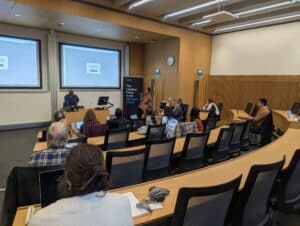
For our last leg, we came in prepared to discuss advanced use cases but were quickly reminded of the need to adapt and be flexible. For all our excitement to deep dive, being mindful of the differences and comfort with utilizing AI means a willingness to change the pace when the group, at large, requires more attention to detail.
At Judge Business School, their inquiries reflected a desire for widening our scope as compared to deepening it. Questions moved through an array of topics, and we were diligent about allowing their curiosity to lead while staying the intended course.
Every opportunity to train people on nebulaONE comes with its own set of perks and challenges, underscoring the need to keep people at the center. Their experience drives ROI, because no product feels user-friendly if its delivery ignores the user‘s motivations. Likewise, our goal of “AI for All“ works best when partnered with hosts who share that mission.
If you’re at an institution that values equitable access and is seeking to use GenAI tools to deliver transformative value, know that our team isn’t only aligned but we’re eager to support.
Let’s explore what AI adoption could look like for your organization. Connect with our team to discuss training, strategy, and responsible GenAI implementation.
 by
by