AI agents are quickly becoming the next frontier of enterprise technology. These systems promise to handle complex tasks, integrate with business workflows, and deliver value through natural conversation. Yet many organizations find that building effective agents is far harder than expected.
Why? Because creating an AI agent is not just about wiring a Large Language Model (LLM) to a chat window. It requires careful design, governance, and iteration to ensure the agent behaves predictably, scales reliably, and aligns with business goals.
At Cloudforce, we help clients move beyond prototypes to deploy secure, governed, and impactful AI agents.
Why Building AI Agents Is Hard
Many enterprise AI initiatives stall before reaching production. When building agents, the challenges are even steeper:
- Vague roles: Agents with unclear responsibilities produce inconsistent or untrustworthy results.
- Unverified data sources: Unvalidated connections introduce errors and compliance risks.
- Lack of governance: Without monitoring, versioning, and iteration, quality and reliability of outputs quickly erodes.
- Cost overruns: Agents that aren’t tuned for efficiency can rack up unnecessary token spend.
These are not just technology problems, they are problems with design, alignment, and process. Enterprises need a structured approach to building impactful AI agents.
A Framework for AI Agent Building
Capturing Requirements
Every effective agent begins with discovery. This is where teams align on what the agent is supposed to do and why it matters.
- Functional requirements: What tasks should the agent perform?
- Non-functional requirements: What security, compliance, or performance constraints must be respected?
- Prioritization of needs: Which needs are must-haves vs. nice-to-haves?
- Integration landscape: What systems, APIs, or knowledge bases should the agent access?
Equally important is understanding user intent and context:
- Which business goals or KPIs will the agent influence?
- When and where in the workflow will users engage the agent?
- What should the agent do when questions are unclear or off topic?
These early decisions help shape the foundation for everything that follows.
Formulating the Agent
Once requirements are clear, the next step is blueprinting the agent’s personality and scope.
- Define agent role: Describe the agent’s identity, tone, and task framing.
- Understand business flow: Determine where the agent fits into existing processes.
- Incorporate data sources: Prescribe what FAQs, PDFs, APIs, or CRM systems are available for the agent to reference.
- Use guardrails: Add safety nets around sensitive topics like PII/PHI.
- Consider ethical implications: Ensure tone is inclusive and professional.
- Determine confidence thresholds: Decide how certain the agent should be before giving an answer
Careful formulation ensures the agent is more than just a “chatbot,” but rather a designed system with a clear purpose.
Agent Design
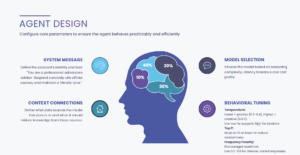
This is where the agent’s core parameters are configured. The four core areas of agent design are:
- System Message: Defines the agent’s identity, task, and tone
Example: “You are a professional admissions advisor. Respond concisely, cite official sources, and maintain a friendly tone.”
- Context Connections: Determines what data sources the agent can access and when. File libraries, APIs, MCP servers, and web search are common options.
- Model Selection: Choose the correct model based on reasoning complexity, latency tolerance, and cost profile that fits your use.
- Behavioral Tuning: Shapes variability, creativity, and consistency by defining parameters like temperature, top-p, and frequency penalties.
Together, these levers influence how predictable, trustworthy, and efficient the agent becomes.
Evaluating Your Agent
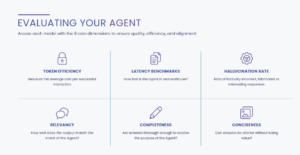
Agents must be tested continuously to ensure continued effectiveness and reliability. We recommend six dimensions for evaluation:
- Token Efficiency: What is the average cost per successful interaction in using your agents?
- Latency Benchmarks: How responsive are the endpoints you use?
- Hallucination Rate: How often do models or agents output incorrect or fabricated responses?
- Relevancy: Does the output match the user’s intent?
- Completeness: Are responses thorough enough to resolve the request?
- Conciseness: Are answers shorter without losing value?
Evaluation should not be a one-time task. Like any enterprise system, agents improve through monitoring, iteration, and feedback loops.
Dos and Don’ts for Success
Do:
- Document iterations and what worked.
- Continuously test agents with edge cases.
- Share prompt patterns across teams.
Don’t:
- Use vague agent roles, leading to unpredictable behavior.
- Rely on unverified data sources.
- Deploy without monitoring or feedback loops.
These simple practices often mark the difference between an agent that quickly fails and one that matures into a trusted enterprise tool.
How Cloudforce and nebulaONE® Simplify the Process
Building AI agents is complex, but it doesn’t have to be chaotic. That’s why we created nebulaONE, a secure, Azure-native platform that allows organizations to build, brand, and govern custom AI agents without code.
With nebulaONE, clients can:
- Deploy securely within their own Azure tenant with full compliance, RBAC, and quota controls.
- Orchestrate multi-agent workflows with patterns like handoff and ask-another agent.
- Monitor adoption, cost, and reliability through built-in analytics.
nebulaONE ensures enterprises don’t just experiment with agents; they deploy them securely, predictably, and with confidence.
 by
by