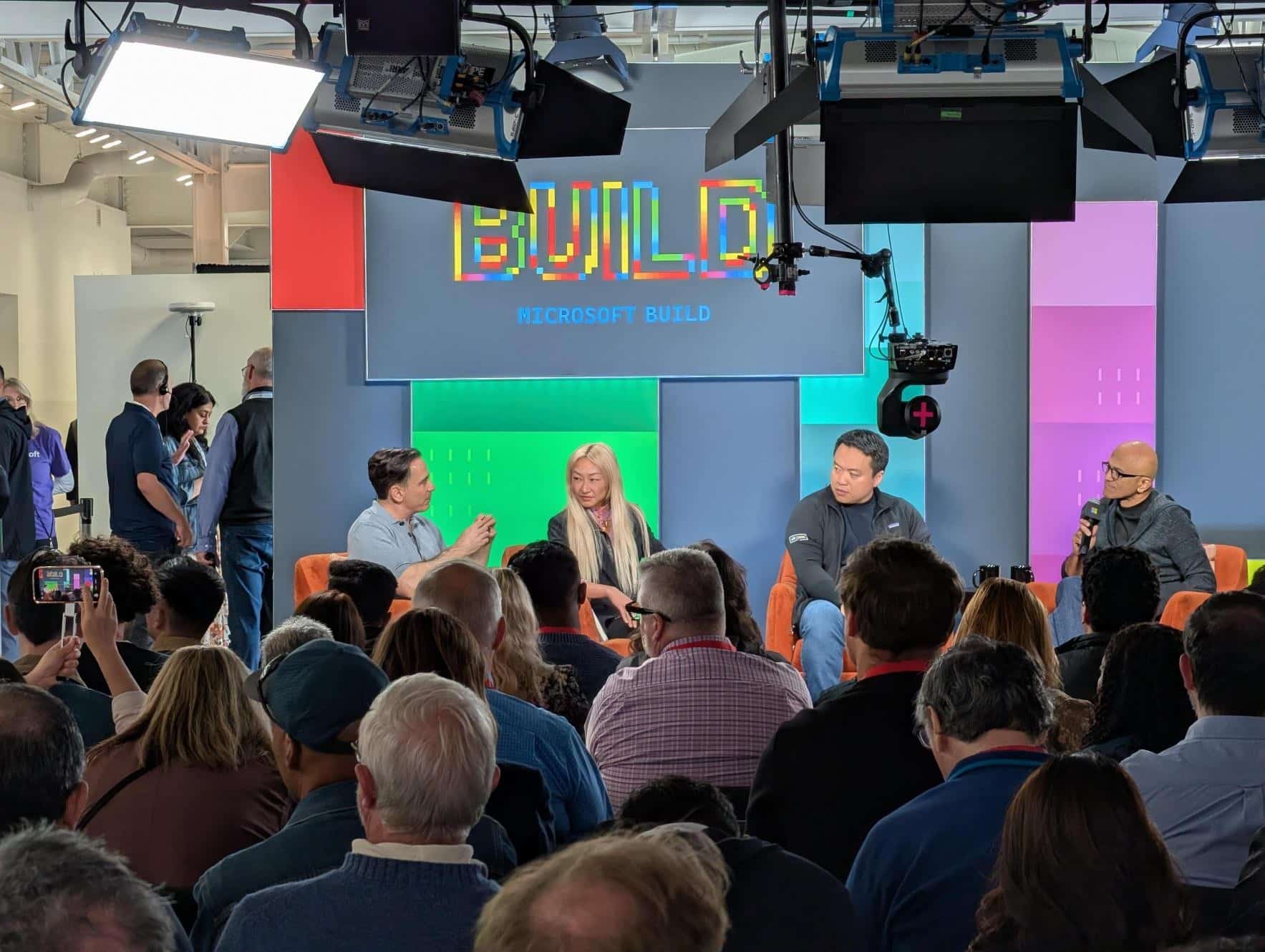
I’ve been going to Microsoft’s big conferences for more than a decade now, and before I dive into what my hot takes are from this most recent iteration, I want to start by acknowledging something more fundamental: this Build felt different.
The last few Builds had drifted. More keynote spectacle, more sales-and-marketing gravity, more time spent telling us what was possible versus showing us all how it’s done. This one was a return to form. It was tighter, more technical, and unapologetically aimed at the people who actually build things. The labs were good. The sessions assumed you were hands-on in the tools. The product reveals came with practical examples instead of sizzle reels. For those of us whose whole job is using Microsoft’s platforms to build something a real user finds delightful, that shift was not inconsequential. It is the difference between a conference that markets to builders and one that equips them, and Microsoft clearly chose the latter this year.
Now, a caveat about the lens I’m using. Almost nothing Microsoft announced was aimed at higher education. There was no education keynote moment, no campus demo, no headline built for a provost, and honestly it would have been strange if there had been. That is not what Build is. But lately I spend my days deep in the higher-ed space, and that immersion is hard to switch off. I walked out of every session running the same question: what does this mean for an institution, for a registrar, for a general counsel worried about student data? Three threads from the week kept setting that part of my brain off, which is why I’m taking the time to write this down. Not because the technology is magic, but because it lands on a problem universities already have, whether or not they’ve named it yet.
Let me start with that problem, because it’s the one I’d be fixated on if I were sitting where you sit.
Your campus already has ungoverned AI agents on it. You just can’t see them.
Right now, today, there are faculty running coding agents on their laptops, grad students wiring up automated research assistants, and freshman piping institutional data through whatever tool got recommended to them in a Discord channel. Some of those tools are genuinely helpful. The point is that none of them are visible to you, and several of them are touching data that lives under FERPA.
This is the part of Build that I think got undersold. Microsoft is building the ability to discover third-party agents running locally on managed devices, things like OpenClaw, Codex, Claude Code, and other agents, to bring them under the same management plane as the rest of your estate. This capability sits on top of Agent 365, Microsoft’s management layer for AI agents, which treats an agent the way you already treat a device or an identity: something that gets enrolled, scoped, and logged.
Microsoft also showed two newer components of the stack: the Agent Control Specification is an open way to declare what an agent is allowed to do and which data it can reach, auditable rather than aspirational. And Microsoft Execution Containers give an agent an isolated sandbox to run in, so it can’t wander into systems nobody authorized it to touch. Neither is finished, but the direction is unambiguous, and the thinking behind it is genuinely sound.
For you, the translation is simple. The question stopped being “should we allow AI agents on campus?” That decision was made for you, by your own community, months ago. The real question is whether you have a way to see what’s already running, prove to your auditors that student data stayed inside your boundary, and shut down the things that shouldn’t be there.
The model isn’t the asset. Your institutional knowledge is, and it’s finally reachable.
The frontier models are quickly converging and becoming commodities. Whichever one you implement this quarter, your competitor down the road can license the same one. What they can’t license is your data. Your advising policies. Your course catalog and prerequisite logic. Your financial aid rules. Twenty years of research output. The actual texture of how your institution works.
The trouble has always been that this knowledge is scattered across your LMS, a dozen line-of-business systems, a data warehouse, and the heads of people who’ve been there long enough to remember why a policy exists. An AI agent that can’t reach this information is no more useful or differentiated than a public chatbot.
Microsoft’s answer at Build was to pull all its grounding layers in under one banner, Microsoft IQ, which includes Work IQ, Fabric IQ, Foundry IQ, and Web IQ. These retrieval layers enable you to build reusable, governed knowledge sources from your existing datasets, without ever moving or copying them, making your institutional information ready for agent consumption.
Strip the branding away and here’s why a CIO should care. The gap between an agent grounded in your governed institutional data and a generic assistant is the gap between a registrar’s office that can answer a transfer-credit question correctly and one that makes something up that a student then relies on. It’s a financial aid agent that advises using your actual rules instead of a plausible guess. It’s accreditation reporting that traces back to a source of record instead of a spreadsheet someone emailed around. The value isn’t “AI.” The value is that the data the AI stands on is the data you already trust, sitting where you can audit it, instead of copied into some vector store nobody on your team is watching.
There was one more thing in this category that I think is quietly the most consequential for a campus over a five-year horizon. Microsoft demoed Rayfin, an open-source tool that generates a full application backend (database, auth, storage, access policies) from a description in code or plain language, and deploys it to Fabric with one command, with the application’s data landing in OneLake by default. Replit is the launch partner for this capability, but any agentic coding platform can use it to turn locally-hosted vibes into production-grade applications.
When I saw Rayfin in action for the first time, I immediately heard the voice of a leading research university CIO that I met with last month saying “I have all these great agent-coded apps we’ve built that are already delivering real value in production, but how am I supposed to manage a thousand of these things across the enterprise?” — it appears he was just a few weeks ahead of the curve with spotting the very real need for a hosting + governance + data layer. Today, every new AI-coded app a department spins up, the advising tracker, the research intake form, the housing tool someone’s office built over the summer, becomes another island of data you have to go find later. With the Rayfin approach, new applications feed the same governed data layer your reporting and your agents already run on. The data asset stops fragmenting with every new project and starts compounding instead.
“We already have [insert AI chatbot here]. Why would we need anything else?”
I hear this constantly, and it’s a fair question, so let me answer it the way Build answered it: Microsoft spent most of the week showing things that aren’t tied to any single end-user product at all.
Microsoft Foundry is the open platform for deploying every model and running any agent. Agent Framework gives you a standard way to compose them and have them talk to each other. The IQ stack unlocks all your existing data assets and makes them immediately valuable for the work agents need to do. And Microsoft now has serious first-party frontier models of its own, the MAI family, which span coding, reasoning, voice, and more.
The thing to take from all of this isn’t any single product. It’s that Microsoft is openly building a platform where specialized agents are meant to run alongside existing first- and third-party products, on the same governed foundation, rather than compete with them.
So the honest framing for a CIO isn’t “ChatGPT or something else.” It’s that you’re most likely going to need to assemble a campus AI strategy out of several components, and the platform Microsoft just laid out is built for exactly that kind of assembly. Watching them lean into open standards and composition instead of a walled garden was, frankly, the most encouraging part of the week.
Where this leaves you
Here’s the catch, and it’s the thing that keeps our team at Cloudforce perpetually busy: every capability I just walked through is powerful on its own and genuinely complex to use together. Agent governance, the grounding layers, Foundry, the models, the backend tooling: each one is real value, and each one is also its own console, its own learning curve, its own bit of plumbing somebody on your team has to build and then keep alive. String five of them together by hand and you haven’t bought capability, you’ve bought a second full-time job for an IT staff member you probably can’t spare.
A quick word of disclosure, since you should know where I’m sitting. I run a company that builds in this space, so weigh this accordingly. We built nebulaONE® for exactly this gap. Not to replace any of what Microsoft showed at Build, but to bind it all together effortlessly. The whole premise is that your team shouldn’t have to learn five consoles, wire up the integrations, and babysit the plumbing just to put governed, grounded AI in front of a researcher or a financial aid counselor. nebulaONE is the single front door that brings all of these Microsoft investments into one governed, genuinely pleasant interface, so the power shows up for your people without the assembly cost landing on your staff.
And here’s the part I actually believe, beyond any pitch: the more Microsoft ships, the more valuable that kind of hub becomes. This Build made the underlying platform stronger and more capable than it’s ever been. It also made it more sprawling. Someone has to make that sprawl feel like one simple, coherent thing to the person trying to help a student. That’s the bet we made early, and it’s the bet Build just reinforced.
 by
by